
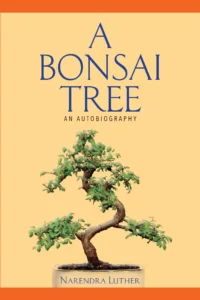

A Bonsai Tree beautifully presents the life journey of a senior retired bureaucrat whose experiences are closely tied to some of the most important moments in Indian history. In the book, Narendra Luther, an Indian writer, historian, poet, and former Indian Administrative Service (IAS) officer renowned for his books on Hyderabad’s history and culture and for his autobiography, A Bonsai Tree: An Autobiography, seamlessly traces his personal and professional life, making it not just an autobiography but also a reflection on the nation’s past.
The book serves not only the purpose of narrating the author’s life story but also presents the hardships of Partition that our country suffered in 1947. Mr. Luther reminds readers of one of the largest migrations in human history when millions of families moved from Pakistan to India. Through his own memories, he shows how this massive displacement affected ordinary lives. He and his family, like millions of Nirwasit and Muhajirs, faced fear, uncertainty, and loss. Yet, despite these tragic events, hope in his heart never loses its charm. This quiet optimism becomes one of the most powerful strengths of the book. One of the best aspects of this autobiography is its language. The writing is simple, graceful, and deeply human. Even when describing painful and tragic events, the tone remains balanced and dignified. The emotions are real but never exaggerated. This makes the narrative both touching and believable.
The book takes us through many memories from different phases of his life. However, it does not feel like scattered recollections. Instead, it remains a complete autobiography through which his whole, messy life unfolds naturally. The title itself, A Bonsai Tree, seems symbolic suggesting a life shaped by circumstances, pruned by challenges, yet continuing to grow within limits.
The author successfully presents a different and unusual perspective on events that we usually read about only in history textbooks. A striking example is the chapter titled “Bloody Independence.” Through this chapter, he explains how Partition shaped the lives of common people. Independence, which is often celebrated with pride, is shown alongside the pain and violence that accompanied it. This honest portrayal gives readers a deeper understanding of history.
Post-Partition hardships and his singular efforts eventually launched the author into a respected and coveted bureaucratic career. His journey from a displaced refugee to a senior civil servant reflects determination, resilience, and dedication. He shares professional experiences with sincerity, without bitterness or self-praise. At the same time, the book is not heavy throughout. Hilarious snippets of a young, slightly bumbling couple add warmth and charm to the narrative. These light moments balance the seriousness of historical events and keep the reader engaged.
Overall, A Bonsai Tree is more than a memoir. It is a story of survival, growth, service, and hope. It offers a deeply personal lens through which we can understand both history and humanity.
Anay is a Research Assistant at PIC’s Cooperative Federalism and Multilevel Governance (CFMG).