
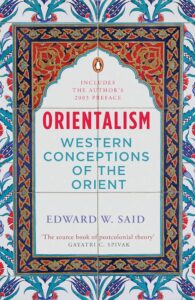

Orientalism, by Edward Said, is one of the most influential works in postcolonial studies, cultural theory, and international relations. First published in 1978, the book fundamentally changed how scholars understand the relationship between knowledge, power, and representation. Said argues that Western depictions of the “Orient”—a broad term historically used to refer to the Middle East, Asia, and North Africa—were not neutral descriptions but part of a structured system that supported European imperial expansion. The book remains widely read because it offers a powerful framework for analysing how cultural narratives shape political realities.
One of the central arguments of Orientalism is that the West constructed the idea of the Orient as fundamentally different from itself. According to Said, European writers, scholars, and administrators consistently portrayed Eastern societies as irrational, backward, exotic, and static, while presenting Western societies as rational, progressive, and modern. This contrast helped Europeans define their own identity and justify their dominance over colonised regions. Said emphasises that these representations were repeated across literature, travel writing, academic scholarship, and government policy, creating a consistent and influential image of the East.
A key strength of the book lies in its interdisciplinary approach. Said draws on history, literature, political science, and philosophy to demonstrate how Orientalist ideas developed over time. He pays particular attention to the role of institutions such as universities, colonial administrations, and research organisations in producing knowledge about the Orient. By linking intellectual work to political power, Said shows that scholarship is never completely separate from the social and historical conditions in which it is produced. This argument is heavily influenced by the ideas of Michel Foucault, especially the notion that knowledge and power are closely interconnected.
Another important concept introduced in Orientalism is what Said calls “imaginative geography.” This term refers to the way people mentally divide the world into regions based on cultural assumptions rather than objective reality. For example, Western writers often described the Middle East as mysterious, dangerous, or timeless, even when those descriptions did not reflect everyday life in those societies. These imagined boundaries created a sense of distance between the West and the East, making foreign intervention appear necessary or justified. In this sense, geography becomes not just a physical reality but a cultural and political construction.
Said also argues that Orientalism functioned as a system of knowledge that supported imperial governance. European empires relied on detailed information about languages, religions, and customs to manage their colonies effectively. Scholars translated texts, mapped territories, and documented local traditions, believing that understanding a society would make it easier to control. This process transformed complex cultures into objects of study that could be classified and administered. In the book, Said repeatedly stresses that knowledge about the Orient was closely tied to the exercise of authority.
One of the most significant contributions of Orientalism is its relevance to contemporary global politics. Although the book focuses primarily on the nineteenth and early twentieth centuries, its insights apply to modern media and foreign policy debates. News coverage, films, and political speeches often rely on simplified images of regions such as the Middle East, portraying them as unstable or inherently violent. These representations influence public opinion and shape government decisions, including military interventions and security policies. By highlighting the persistence of these patterns, Said demonstrates that Orientalism did not disappear with the end of colonial rule; instead, it adapted to new political contexts.
Some scholars argue that Said presents the West as too unified and overlooks differences among European writers and institutions. Others suggest that he focuses primarily on Western perspectives and pays less attention to the voices of people from the regions being studied. Critics have also questioned whether all Western scholarship about the East should be considered part of an imperial project. These debates have encouraged ongoing discussion about the relationship between culture and power.
Nevertheless, the lasting impact of Orientalism is difficult to overstate. The book helped establish the field of postcolonial studies and influenced disciplines ranging from literature and anthropology to international relations and media studies. It encouraged scholars to question assumptions about cultural difference and to examine how language and representation shape political realities. Even decades after its publication, the book continues to be widely cited in academic research and public debate.
In conclusion, Orientalism is a challenging but essential work for understanding how knowledge about other cultures is produced and used. Said’s central message—that representations of the East are deeply connected to systems of power—remains highly relevant in today’s globalised world. By exposing the historical roots of cultural stereotypes and political narratives, the book invites readers to think critically about the ways societies describe one another. For students of international relations, literature, or cultural studies, Orientalism provides a valuable framework for analysing the complex relationship between knowledge, identity, and authority.
Dr. Koena Lahiri is a Policy Research Associate for Geopolitics & Geoeconomics (G & G).