
More from Less for More (MLM) is published by Penguin Business, an Imprint of Penguin Random House. Currently available in hardback, the 234-page book has the wisdom of the ancient India and the thoughts of the modern technological world. It’s a treatise that argues that every individual deserves equality and the dignity of living, and that all of us are responsible for providing it to the last individual in the social hierarchy. What it means is the ability to deliver technology to the poorest and at the lowest cost without compromising on its quality. Acronymed as MLM, the cover displays an equation, meaning that when you build the capacity to make more from less, the results would be exponential and limitless.
The book is divided into chapters that use numerous real-life examples to explain its contents. It starts with defining the philosophy of how ‘Jio’—the Reliance global telecommunication services business—defied all odds and advice and jumped onto the data wagon when no one else dared. Jio innovated, embraced, and rolled out Jio services on mobile phones, which have now become the fastest platform to connect, do business, watch cricket matches, and even watch programmes on the OTT platforms. As the authors state, The Pradhan Mantri Jan-Dhan Yojna may have widened India’s banking access, but it has been Reliance Jio services that have accelerated widespread adoption. All of the above, at the cheapest cost in the world.
The authors are sanguine about the inequality in India and argue that the time has come for us to adopt the MLM strategy. It is fascinating to read the live case studies cited by the authors to support their argument about MLM effectiveness—from ‘Swaasa’, an innovation to detect lung-related disorders simply by coughing into a device like a smartphone and get results that otherwise cost over five figures in INR (Indian Rupees), to I-Breast, an easy gadget to detect breast cancer in Women. And in between many more, like the Dozee, which monitors contactless cardiovascular health by listening to heartbeats; and Aaraca, through non-invasive thermal imaging, provided a health check-up for an individual in one minute at an unimaginably low cost of Rs 50. One of the finest examples of public service to the underprivileged workers is the invention of the Bandicoot—the Robotic arm which replaced manual scavenging in the deepest, darkest, dirtiest, and dangerous underground sewers of Kochi. Done through Genrobotics, the book describes this pathbreaking discovery in great detail. Many more such MLM endeavours—like ‘Save Mom’, ‘Oral Scan’, ‘Dengue Test’, ‘Axiostat’ for stopping blood loss in accidents or on the battle field, and finally ‘Sanket’, the hand-held ECG machine which won this year’s (2025) Anjani Mashelkar award—are all examples how entrepreneurs have invented simple gadgets to replace complex machinery and tests to monitor human health. A yeoman service to the poor through the MLM way.
The book also covers ISRO’s case study of sending the Mars mission ‘Mangalyaan’ at one-tenth the cost of NASA, and the success of the Jaipur project in giving people who have lost a limb a sense of everyday life and hope. The book explains government policy innovations like UPI, the unified payments interface; Ujjwala, a scheme to provide LPG connections; and the light bulb innovation, which changed the way people light their houses by using LED bulbs—cheaper and less electricity consuming. Replete with examples, the book covers all walks of life from education to entertainment, and practices which promote the MLM principle.
The last chapter of the book carries the interview with Dr. Mashelkar by Mudar Pathreya, a Heritage activist, Coach, and Kolkata restorer. The interview is about Dr. Mashelkar’s bid to profess MLM—why it is important, and how he and Shri Sushil Borde, through the Anjani Mashelkar Foundation, started in honour of Dr. Mashelkar’s mother, have promoted MLM to help reduce inequality.
The book ends on a positive note, in which Dr. Mashelkar has expressed his deep confidence in the talent that lives in India, and its ability to deliver exponential results that would flow from the MLM way of life.
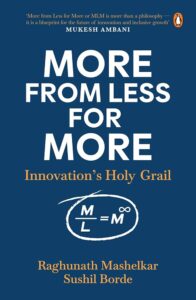
More from Less for More: Innovation’s Holy Grail, by Raghunath Mashelkar & Sushil Borde
