
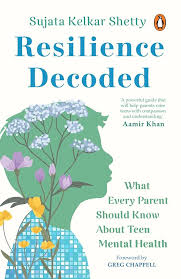

The above book is published by Ebury Press, an imprint of Penguin Random House. The sleek 173-page book has a thoughtful and well-designed cover that befits the title. Seldom does one come across a book that offers wisdom, value, and life lessons far in excess of its volume. Resilience Decoded is one such book. It does not matter if you are a parent or an adult; the wisdom encapsulated applies to all. The intended audience of this book is the parents of teenage children, yet it can be read by older adults, adults, and adolescents. The narration is simple, appealing, and logical. There are nuggets embedded in every chapter, which can be quoted and preserved as quotable quotes; some are listed at the end. The book is a guide, and I dare say it may well become a bible for Parents of Adolescent children. A progression of Dr. Spock’s Baby and Child Care applicable for adolescent children and their parents. Aamir Khan has endorsed the book, and the Foreword is by Greg Chappell.
The four chapters of the book are aptly sequenced, and each carries a well-intended argument. The Ferrari Brain explains that the adolescent’s brain is still developing, and that they make decisions driven by the amygdala, rather than the prefrontal cortex, making their actions appear less rational and more emotional. This scientific explanation should pacify many parents who seem exasperated by their teenage children’s behaviour. The heart-wrenching story of a teenage suicide, as narrated by her mother, can never leave any parent untouched by the knowledge that a bit of awareness and understanding could have saved a bright child. The need for physical activity in our daily lives, and proper sleep are key to healthy minds, forming the theme for the second chapter. The dangers of social media, the internet, and porn for young minds make one aware of how vulnerable the teens are to the modern-day tech-driven world as they navigate an environment which is far more toxic than their parents had ever encountered. The fourth and final chapter is devoted to the parents of teenage children. Parenting is challenging, and parents should avoid self-criticism, since low self-respect can affect their children’s mental health. This chapter is the most telling of all and provides parents with insight into how to deal with their teenage children.
‘Teenagers do not lack intelligence; they navigate life with brilliance. What they lack is the neurological scaffolding to harness their brilliance consistently.’
‘Learning would be extremely laborious, not to mention hazardous, if people had to rely solely on the effects of their own actions to inform them what to do. ‘(Albert Bandura)
‘Resilience is not the absence of suffering, but the art of transforming pain into wisdom without letting it steal your softness’.
‘It’s not only children who grow, but parents grow too. As much as we watch to see what our children do with their lives, they are watching us to see what we do with ours. (Joyce Maynard)
‘Parenting is the world’s hardest job, and we are never formally trained for it. ‘
‘Overprotection breeds fragility; allowing struggle fosters problem-solving and grit. ‘
The above are only a few short nuggets; as stated earlier, throughout the book, one comes across many such expressions of wisdom and quotes. The author has taken the reader on a journey that every individual, whether a parent, an adult, or an older person, experiences every day. She has scientifically explained every myth and belief about how to bring up teenage children. At the centre of the book’s narrative are teenage children and the author’s deep concern for their adolescent years. It is thus no wonder that she has dedicated this book to her two growing sons. This book is a must read for all parents who have teenage children.
Maj Gen Gadkari is Director, PIC.