
History shows that India has always been at its most creative and influential when it is at its most connected, plural, hybrid, open and receptive to new ideas from its neighbours when it represents the cohabitation, not a clash, of civilisations. Its greatest gift lies in its ability to absorb outside ideas and influences and take them forward in dramatic, creative, unorthodox and innovative ways, performing repeated feats of self-transformation and reincarnation. There lies much of the source of its strength (Dalrymple, 2024, p. 298).
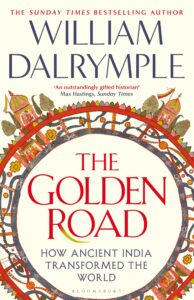
In his recently published book, The Golden Road: How Ancient India Transformed the World, William Dalrymple delves into this very essence of India’s cultural and economic influence on the ancient world. The author presents meticulous research that posits ancient India as a global force of creativity, innovation, and exchange.
Dalrymple, a Scottish historian and author, is known for his explorations of South Asian history and culture. Based in India, he has authored numerous books including The Age of Kali, a collection of essays on India; City of Djinns, a history of Delhi and The Last Mughal, which is about the decline of the Mughal Empire. He is also a Fellow of the Royal Society of Literature and of the Royal Asiatic Society, and is the founder of the Jaipur Literature Festival.
The central theme of The Golden Road postulates India’s historical ability to adapt to foreign influences. Dalrymple begins with the rise of Buddhism in ancient India and its transformative impact across Asia. He illustrates how Buddhist monasteries became hubs of intellectual and trade exchanges. Foreign visitors to these monasteries carried India’s knowledge and philosophy to Burma, Thailand, Java, Sumatra, Cambodia, and Vietnam. Such exchanges established India as a beacon of cultural and intellectual prosperity.
The author also challenges conventional narratives by asserting that India, rather than China, was the Roman Empire’s principal trade partner. He traces the maritime trade network, extending from India’s eastern coast across the Bay of Bengal to emerging city-states in Southeast Asia, including Java and the South China Sea, in the 4th century BCE. Dalrymple emphasises that Mediterranean sailors began venturing eastward to India as early as 510 BCE, underlining the nation’s significance in global trade routes.
The book sketches the transmission of India’s spiritual heritage. Dalrymple reiterates the story of the Lotus Sutra, translated by Kumarajiva, which became a foundational Buddhist text in China. India’s Yoga diplomacy started long before when Xuanzang, a Chinese scholar and devotee of Nalanda University, documented his journey to India in search of authentic Buddhist teachings. Xuanzang’s pilgrimage traversed the intellectual, spiritual and cultural links between India and China.
The author also examines the role of prominent historical figures such as Wu Zetian, China’s first female ruler, who critically made Buddhism the official state religion during her reign. Under Empress Wu’s patronage, Luoyang—Heavenly City of the Bodhisattva Maitreya—became an epicentre of Buddhist culture in China. Through such narratives, the author underscores how India’s religious and cultural ideas travelled and took root in far-off lands.
Another fascinating aspect of the book is its exploration of India’s literary and artistic influence. The epics Ramayana and Mahabharata still resonate across the Southeast Asia. The Hindu and Buddhist temples constructed in the region during the 8th century became not only the places of worship but also the symbols of India’s soft power.
Apart from literature, the book discusses India’s profound contributions to science, mathematics, and astronomy, which influenced the West. The solid works of Aryabhatta, Brahmagupta, and Varahamihira laid the foundations for significant advancements in these fields. The ancient Indian board game called ‘Chaturanga’ was introduced to the Arab-Islamic world in the form of chess, further showcasing India’s far-reaching cultural exports.
Dalrymple mentions that the Mongol invasions disrupted the already established trade networks, reducing the trade and giving rise to maritime commerce. During the same period, the Persian language and culture left a long-lasting imprint on India. By the 1700s, South Asia had become the leading centre for Persian literature, with a literate Persian-speaking population seven times larger than Iran’s.
In the final chapters, Dalrymple poses the question of whether India, China, or the United States will dominate the world by the end of this century. He reflects on India’s historical strengths—its ability to connect and cohabit with other civilisations, the source of its resilience and influence.
The Golden Road does more than recount India’s history; it seeks to reshape perceptions of its role in world history. Dalrymple makes a persuasive case that India was a cultural and spiritual hub and a vital economic engine on par with China in the ancient and early medieval world. He highlights India’s influence extended far beyond its borders and moulded the cultural and intellectual fabric of Asia, the Middle East, and the Mediterranean. The book gives insights into India’s strategic thought and primitive diplomacy. It sheds light on these foundational principles that shaped today’s interconnected world.
Dalrymple’s storytelling ability and entrancing anecdotes makes The Golden Road an engaging read. Whether you are a history aficionado or curious about the roots of a globalised world, The Golden Road is a book that will stay with you long after you have turned the last page.
(Hritika Patil is an Intern at PIC)